
Over the past few months, we followed the tenth season of live broadcasts from the stork nest in Vlaha. Of all the seasons we have watched, this was by far the saddest.
Back in spring, we were still hoping that the stork from Dumbrăvioara wearing ring 8031 would return with its mate and that the two of them would breed in the nest once again. We had cleaned up the collapsed side of the nest and were planning to try to catch one of the adult birds and fit it with a tracking device. We had already started looking into trapping and baiting techniques, possible sources for the transmitter, and ways of allowing followers of our website to contribute voluntarily towards the cost of purchasing and operating the device.
But we never even got around to announcing these plans, because it became clear at the very beginning of the stork season that we could not expect stability or a normal family life in the nest this year either.
The nest was occupied unusually late, on the 10th of April. This time, however, it was not last year's ringed stork that arrived, but a young pair that appeared to have little experience. The first egg was laid very late, on the 22nd of April, followed by two more, two days apart.
Even without any further tragedy, it would have been difficult for the pair to hatch and raise their chicks before the late-summer migration. Sadly, tragedy did strike—and in the least expected way.
Last year's resident, the Dumbrăvioara stork wearing ring 8031, also arrived late this year, landing in Vlaha on the afternoon of the 3rd of May. It drove away the female, who had been left alone in the nest for a few hours, and began throwing the eggs out. It was only chased away when the young male returned. Together, the pair managed to reclaim their nest.
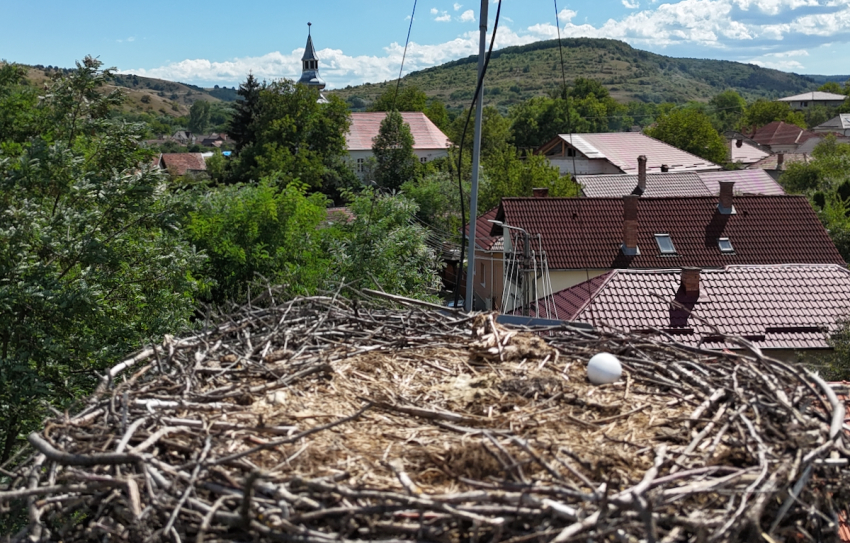
One of the eggs, however, did not fall to the ground. It became caught among the branches along the edge of the nest, giving the parents a chance to save it. They rolled it back into the centre of the nest and continued taking turns incubating it for many long weeks.
The chick should have hatched by the 1st of June at the latest, but the parents had no way of knowing that there was no life left inside the egg. Instead of the usual 34 days, they continued incubating it for an extraordinary 64 days.
It was not until the nights of the 21st and 22nd of June that they first left the egg unattended overnight. Even then, they continued taking turns sitting on it until the 25th of June. By that point, it had finally become clear to them that they would not be adding a new generation to their family this year.
The realization must have been a bitter disappointment. After that, they hardly returned to the nest at all.
They spent their last night at home between the 25th and 26th of June. In the following weeks, they visited the nest only for a few minutes at a time, and eventually entire days passed without either bird appearing.
On the 13th of July, one of them may have tried to remove the egg, as it was found on the northwestern edge of the nest. On the 15th of July, following another apparent attempt, the egg appeared on the southern edge of the nest. It remains there to this day.
Visits to the nest became increasingly rare, and on the 31st of July we recorded the last one. That morning, the pair spent an hour and a half together in the nest. Since then, the camera has not recorded even a passing stork.
This year taught us just how harsh and unforgiving life can be for wild animals. A single misfortune—a few hours in which the male happened to be away—was enough to leave an entire family without offspring.
Yes, this too is part of the life of storks. This too is part of nature.
Even so, we hope that next year we will once again be able to follow a peaceful, stable family life in the nest—and perhaps finally return to our plans to fit one of the storks with a tracking device.
The members of this year's project team were:
Gazda Árpád, journalist and neighbour of the nest, author of the photographs and news updates;
Dr. Szabó D. Zoltán, biologist and scientific coordinator of the observations;
Gazda Flóra, student and translator of the English-language news updates;
Lázár Lehel, website developer;
Okos Zsolt, technical expert responsible for the live broadcast and network-related issues.
All of us are volunteers in the stork monitoring programme.
Thank you for following along with us again this year.
We hope to welcome you back in March 2027!